

Table Of Contents
For many paddlers, September marks the point when the paddleboard disappears into storage until the following spring. Yet some of the best quiet paddleboarding destinations UK paddlers can explore become noticeably more appealing once the busiest summer weeks have passed.
Popular lakes become less crowded, waterside car parks can feel calmer and early autumn brings a completely different character to familiar landscapes. Green hills begin turning gold, mist settles across the water and the low morning sun can make even a regular paddling spot feel new again.
There is one important difference: autumn SUP requires more preparation than a spontaneous midsummer session.
Cooler water, shorter days, changing weather and fewer seasonal facilities all need to be factored into your plan. Get those decisions right, however, and peak season ending certainly does not have to mean the end of your paddleboarding season.

Why Quiet Paddleboarding Destinations in the UK Are Better After Summer
July and August naturally attract the largest numbers of holidaymakers to Britain's lakes, lochs and waterways. Paddleboard hire centres are busy, beaches are fuller and popular launching spots can become crowded during warm weekends.
By September, the atmosphere often changes.
For paddlers prepared to choose their weather window carefully, there are several advantages:
Less congestion around popular launch areas, particularly outside weekends and school holidays.
More space on the water for relaxed cruising and practising skills.
Cooler conditions for longer paddles when the sun is out.
Changing woodland and mountain scenery.
Greater opportunities for peaceful early-morning sessions.
A chance to experience familiar destinations from a completely different perspective.
Autumn should not, however, be treated as a guarantee of empty water. Popular locations remain popular, particularly during settled weekends.
The better strategy is to combine shoulder-season timing with an early start, sensible route choice and flexible plans.
What Makes a Good UK Autumn Paddleboarding Destination?
The most remote piece of water is not automatically the best choice.
In autumn, a good SUP location should give you options. Sheltered shoreline sections, straightforward exit points and the ability to shorten a route can be far more useful than committing to an exposed crossing.
Before you launch, ask:
Can I stay relatively close to shore?
What happens if the wind increases?
Is paddleboarding permitted here and do I need a licence or permit?
Are there alternative exit points?
How cold is the water likely to be?
How much daylight do I realistically have?
Will facilities still be operating outside summer?
Access to inland water varies considerably across England and Wales, so never assume that being able to see a lake means you automatically have permission to paddle it.
With those considerations in mind, here are five UK destinations worth considering after peak season.
1. Ullswater and Derwentwater, Lake District
There is an obvious reason the Lake District becomes crowded in summer: the scenery is exceptional.
That same scenery becomes arguably even better as autumn reaches the fells.
Ullswater and Derwentwater are both established paddleboarding destinations, and the Lake District National Park currently lists canoes, kayaks and paddleboards as permitted on both. Derwentwater has restrictions on accessing its islands, while local byelaws apply on both waters.
Why Go After Peak Season?
An early autumn morning can bring glassy-looking water, mist around the surrounding slopes and considerably less activity around some popular shoreline areas.
Ullswater is particularly striking when the surrounding woodland starts to change colour, while Derwentwater gives you classic views towards the surrounding fells.
Do not mistake picturesque conditions for guaranteed easy conditions. Large lakes can become difficult when wind increases, and an outward journey that feels effortless with the wind behind you can turn into a demanding return.
Best For
Autumn Approach
Stay closer to your chosen shore rather than automatically planning a lake crossing. A shoreline route can deliver just as much scenery while giving you more options if conditions deteriorate.
2. Loch Lomond, Scotland
For scale and variety, Loch Lomond is difficult to beat.
There are islands, sheltered sections and large stretches of genuinely open water, which means your experience can change dramatically depending on where and when you launch.
The National Park describes areas around the islands as offering more sheltered paddling, while its open expanses are more appropriate for capable paddlers prepared for open-water conditions.
That distinction becomes even more important after summer.
Why Autumn Works
The combination of wooded islands, mountains and softer autumn light gives Loch Lomond an atmosphere that is difficult to replicate during a busy midsummer afternoon.
Choose a settled weekday and you may experience an entirely different side of one of Scotland's best-known outdoor destinations.
Current Loch Lomond byelaws require appropriate lifejackets or buoyancy aids to be carried for everyone aboard relevant vessels, with those under 16 required to wear appropriate flotation while under way in the specified circumstances. The National Park strongly advises paddleboarders of all ages to wear a buoyancy aid.
Best For
Do Not Underestimate the Scale
Seeing the opposite shore does not make a large loch sheltered water.
Wind can create significant chop, and conditions in one part of Loch Lomond may not reflect those elsewhere. Keep your autumn ambitions conservative and have an alternative route ready.
3. Llyn Tegid, Eryri, Wales
Llyn Tegid, or Bala Lake, offers a different type of mountain paddle.
Surrounded by southern Eryri scenery, it gives paddlers a broad expanse of freshwater without the volume of powered recreational traffic associated with some larger lakes.
Paddleboarding is permitted, but a watersports permit is required before launching. The National Park currently allows permits to be purchased from the pay-and-display machines around the lake.
Why Visit in Autumn?
Summer sees the lake used by a wide variety of watersports. Once the main holiday season subsides, cooler mornings and changing colours in the surrounding landscape can create a much more peaceful paddling experience.
Llyn Tegid is still substantial open water. Eryri National Park specifically warns that conditions can change rapidly.
The sensible autumn plan is therefore not to decide your distance before you arrive.
Assess the actual wind, temperature and visibility first, then choose a route that suits them.
Best For
4. Norfolk and Suffolk Broads
Autumn paddleboarding does not have to involve mountains.
For slower-paced exploration, the Norfolk and Suffolk Broads provide a network of rivers, broads and quieter backwaters that feels very different from Britain's open lakes and lochs.
The Broads Authority describes paddle craft as a way to access some of the area's quieter backwaters, making this particularly relevant for paddlers who value exploration over covering huge distances.
Why Go After Summer?
The Broads remain working, shared waterways, but the end of peak holiday season can reduce some of the recreational pressure found during the busiest weeks.
Reed-lined channels and low landscapes also suit the atmosphere of autumn remarkably well.
There is an important access point to remember: paddleboards used within the Broads navigation area require an appropriate toll unless covered through qualifying Paddle UK membership.
Best For
Watch for Other Craft
Quiet does not mean empty.
Stay visible, understand navigation rules and give larger craft sufficient room. Narrow waterways demand awareness even when conditions are flat.
5. Loch Morlich, Cairngorms National Park
Loch Morlich combines mountain scenery with a more accessible scale than many larger Scottish lochs.
Its sandy shoreline, Glenmore Forest surroundings and views towards the Cairngorms make it an appealing destination for a crisp autumn session.
Cairngorms National Park identifies both Loch Morlich and nearby Loch Insh as established watersports locations with facilities, coaching and equipment hire. It also advises paddlers to respect conservation zones and any seasonal wildlife restrictions.
Why Autumn Suits It
Forest colour and the mountain backdrop become increasingly dramatic as the season develops.
The colder Highland environment also reinforces one of the most important autumn SUP lessons: plan around water temperature, not simply how pleasant it feels standing on the beach.
Best For

UK Quiet Paddleboarding Destinations Compared
Destination |
Region |
Best For |
Autumn Appeal |
Main Consideration |
Ullswater & Derwentwater |
Lake District |
Scenic lake paddling |
Autumn fells and quieter mornings |
Wind exposure |
Loch Lomond |
Scotland |
Bigger SUP adventures |
Islands, woodland and mountain views |
Scale and changing conditions |
Llyn Tegid |
Wales |
Mountain lake paddling |
Eryri scenery after summer |
Permit required |
Norfolk & Suffolk Broads |
East Anglia |
Slow touring |
Quieter backwaters and wildlife |
Navigation toll and other craft |
Loch Morlich |
Cairngorms |
Accessible scenic paddling |
Forest colour and mountain backdrop |
Cold water and Highland weather |
Autumn Paddleboarding Safety: What Changes After Summer?
One of the most common mistakes is assuming that a mild September afternoon creates summer paddling conditions.
Air temperature and water temperature are two very different measurements.
Falling into cold water can immediately affect breathing, movement and decision-making. As the season progresses, clothing and equipment choices need to become more conservative.
Autumn SUP Essentials
Consider taking:
An appropriate buoyancy aid or PFD.
Clothing chosen with possible immersion in mind.
Warm dry layers stored in a waterproof bag.
A waterproof phone or reliable communication method.
Drinking water and a high-energy snack.
A small repair kit.
A light if your return could approach dusk.
An environment-appropriate leash system.
A clear route plan shared with somebody ashore.
Leash choice depends on the environment. Moving rivers, tidal waterways and areas with entrapment hazards require different safety considerations from straightforward open-water lake paddling.
If you are uncertain, use recognised training and environment-specific guidance before heading out.
Five Common Autumn SUP Mistakes
Dressing for the Air
You may feel warm while inflating your board in the sunshine.
That tells you very little about how you will feel after an unexpected swim.
Dress for the consequences of entering the water, not just for standing beside it.
Leaving Too Late
September and October rapidly remove the long evenings paddlers become used to in June.
Give yourself a generous daylight margin rather than aiming to reach the car just before sunset.
Letting a Quiet Location Encourage Overconfidence
Having fewer people around is part of autumn's appeal, but it also means there may be fewer people nearby if you need assistance.
Quiet water calls for greater self-reliance, not less preparation.
Ignoring the Return Journey
A light tailwind can disguise how hard the journey back will become.
Plan the entire route, not simply the first half.
Relying on Summer Facilities
Hire centres, cafés, toilets and visitor facilities may reduce their hours after peak season.
Check your essentials before travelling and carry what you need to operate independently.
Choosing a Paddleboard for UK Off-Season Adventures
Having your own inflatable paddleboard becomes particularly useful once seasonal rental centres begin reducing their hours.
The best board depends on where and how you paddle rather than simply choosing the most technical model available.
Bluefin Cruise: The UK All-Rounder
For paddlers wanting one board for lake sessions, sheltered coastal water and general recreational touring, the Bluefin Cruise is designed as a versatile all-round SUP.
Its combination of stability and responsive handling makes it particularly relevant if your autumn adventures vary from one weekend to the next.
Versatility matters during shoulder season because your original plan may need to change with the weather.
Bluefin Lite: When Portability Matters
Some of the best autumn sessions begin away from the busiest car parks.
For train travel, smaller vehicles or walks to suitable launch points, the Bluefin Lite prioritises compact packing, lower weight and straightforward handling.
It can be particularly useful for beginners and casual paddlers who value easy transport.
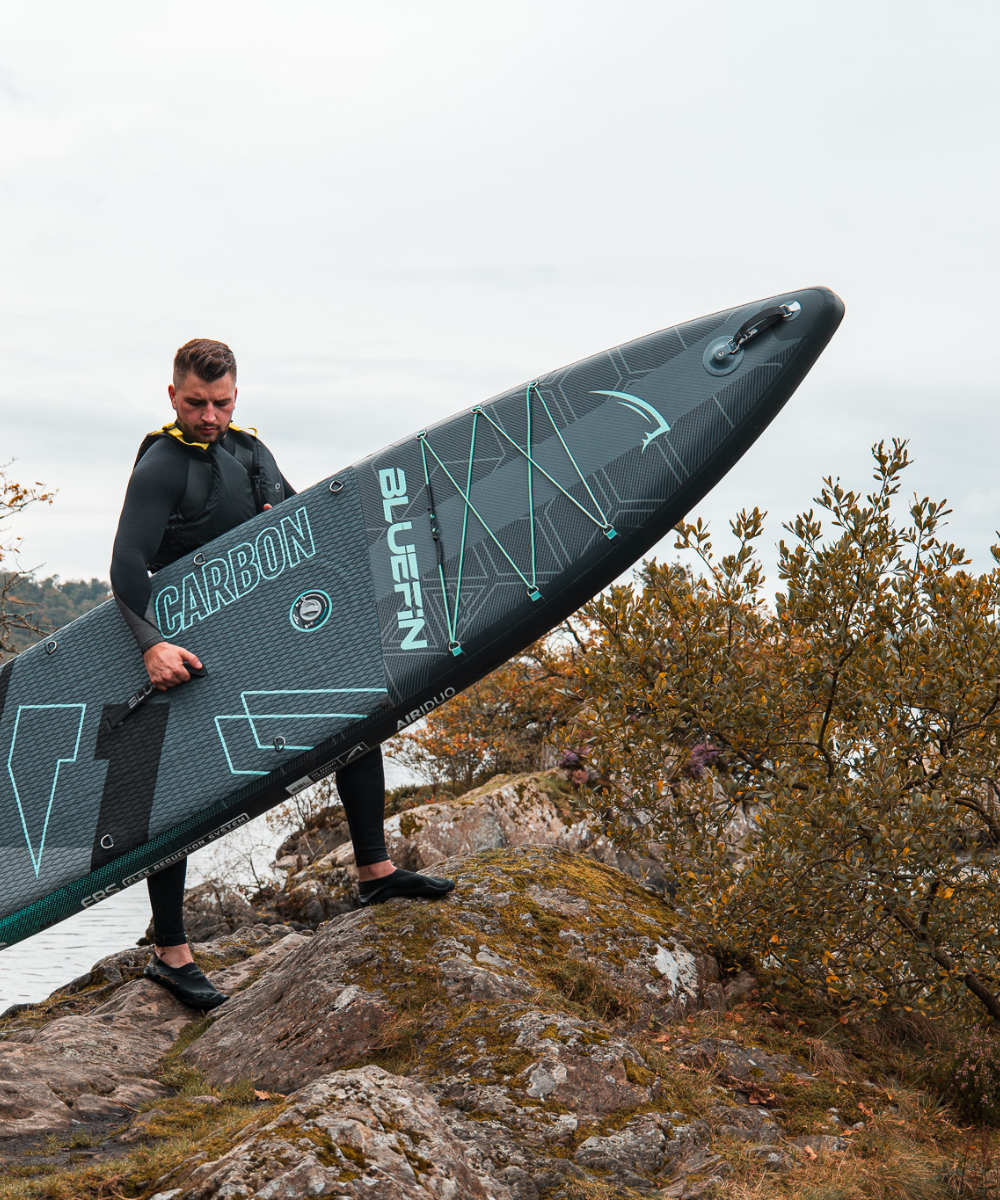
Bluefin Carbon: For Longer Touring Plans
If your paddling increasingly involves longer distances and more performance-focused touring, the Bluefin Carbon is designed around greater stiffness, control and efficient paddling.
Whatever you choose, equipment should expand your options rather than encourage you to paddle in unsuitable conditions.
A high-performance board cannot make poor weather safe.
Paddle Quietly and Leave the Water Better
Autumn landscapes often feel more peaceful because wildlife and natural spaces are experiencing less human pressure.
Keeping them that way is part of responsible paddleboarding.
Follow local access restrictions, avoid disturbing birds and wildlife, use recognised launch areas and take everything you bring onto the water home again.
When moving equipment between different waterways, following Check, Clean, Dry biosecurity guidance can help reduce the spread of invasive species. Loch Lomond National Park specifically recommends the approach for watersports equipment.
Bluefin's wider Eco Positive approach focuses on areas including reducing packaging waste, using recycled materials where possible, supporting conservation initiatives and designing equipment with longevity in mind.
That emphasis on longevity also connects with Bluefin's Built to Last approach: equipment designed for years of use makes more sense than treating an inflatable SUP as disposable summer gear.

Summary: Finding Quiet Paddleboarding Destinations in the UK
Some of Britain's most popular waters reveal a very different personality once July and August are behind you.
The Lake District delivers autumn colour and iconic fell scenery. Loch Lomond gives experienced paddlers an enormous landscape to explore. Llyn Tegid combines Welsh mountains with accessible paddling, while the Norfolk and Suffolk Broads reward slower exploration. Loch Morlich offers one of Scotland's most distinctive mountain-and-forest settings.
The common thread is preparation.
The best quiet paddleboarding destinations UK paddlers can enjoy after peak season are not necessarily secret locations. Often, they are familiar places visited at a better time.
Start earlier. Choose settled weather. Stay flexible. Respect access rules. Dress for the water temperature. Keep your routes conservative when conditions demand it.
Do that and autumn does not feel like the end of the SUP season.
It feels like the beginning of a quieter one.
Find a SUP suited to your next UK adventure, whether you are planning calm autumn lake sessions, compact weekend trips or longer touring routes.
Share:
When to Upgrade Your Paddle Board: 7 Signs It’s Time
Autumn Paddleboarding UK: Balance Work and SUP Time